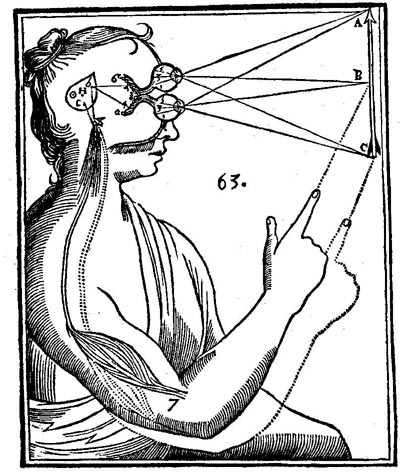
I could move bottle caps and flags with my mind. I'd think "push" and I'd get a ripple or skip the first few times. Then I got to be really damned good at it, and I started to wonder what the good of it was. I mean, how should I use it? And in the dream, after opening a package that came in the mail no-hands no-scissors look ma, I thought, look the ultimate thing to do is to learn how to fly. If you can move stuff with your mind, surely you can move yourself, right? --But I think I thought of flying because I could think of nothing extraordinary to be done with my telekinesis.
Any ideas?
Monday, September 27, 2004
Monday, September 20, 2004
I'll not, not
since 3 am or before, wake up, since I am moving stuff again in my sleep. One year, one month, and still someone fixates on the details. Where will the boxes come from, where do the piles come from, where's the cord file print rock wire hanger lotion clothes fit unfit coming from, supposed to go? Where to find a bulb for this lamp (I'll not get there in time, carrion comfort)? And where to leave it, find it before leaving? Visit the dumpsters at night, Salvation Army at night, Wegmans at night: find map enough for a year: though you can't buy tofu you can eat in this town: though you can get barbecue meatloaf at the deli: though you lose your cat the moment you arrive in the new house: heartbreak. You take heart, set the trap latch and the can of food under your new back door halogen each night and catch, at last, your vomit and shit-smeared raccoon the society would euthanize on your behalf if you don't get over your rabies shakes, take the poor devil back home, and set him free. I nearly shit my own pants when I found him and God he stank. Still that reek in the trunk when the damp settles in, bejeezus. This time last year I loaded him into the car, my coon, and missed my cat and Ithaca much as I bitched for six years about both. He was miserable, that guy. I got him: he'd lost his stuff. I wasn't sure, once I'd lifted the trap door and rattled the cage to set him off, he'd find it again. Haven't seen him since.


Thursday, September 16, 2004
Out, out,
I'd driven myself a long way. I'd thrown
down my garments, walked the brick factory mentioning
to myself the gutter-run stink and late rot, a soft
black mosaic I notice: he is here somewhere. The station
four-way is clogged with cars, I hear the train
a ways off, and the auto-repair shop on the street of old
houses would get up, lying, if I called for help. Help. Here
without others counting the one mossed concrete
stoop and a bike fender spoking queen anne's lace, it
wants. I do. He bodies these ones and I consider
going: the tin-foiled windows at the corner house, their life
stare, the padlocked tackle-and-bait panicking black
and orange: open: open: go: these: into the open
fields of corn, soy, the tracks running through, away, and
the unsigned crosses numbered n 300, n 150, a road at at time, a line,
the sky also a line--is it really impossible?--that, pulled to
the shoulder feeling not this but this
shoulder and sea, he drives by, slows, backs me not
a foot, his elephant black truck backing, slowing, lone?
I am alone too, he steps down. Thought you were broken
down he says. In a corn field, yup, just changing
the tape I say. He lowers his arms--okay now?--moves
towards me, big in his body, full of blood. Lowers
his head. Nods. I don't know I've been looking
for him. He folds his hands at his face. See him
again, m'dear? Oh it's years till I'd betray myself, me,
by myself and him long gone. Only that. only that.
down my garments, walked the brick factory mentioning
to myself the gutter-run stink and late rot, a soft
black mosaic I notice: he is here somewhere. The station
four-way is clogged with cars, I hear the train
a ways off, and the auto-repair shop on the street of old
houses would get up, lying, if I called for help. Help. Here
without others counting the one mossed concrete
stoop and a bike fender spoking queen anne's lace, it
wants. I do. He bodies these ones and I consider
going: the tin-foiled windows at the corner house, their life
stare, the padlocked tackle-and-bait panicking black
and orange: open: open: go: these: into the open
fields of corn, soy, the tracks running through, away, and
the unsigned crosses numbered n 300, n 150, a road at at time, a line,
the sky also a line--is it really impossible?--that, pulled to
the shoulder feeling not this but this
shoulder and sea, he drives by, slows, backs me not
a foot, his elephant black truck backing, slowing, lone?
I am alone too, he steps down. Thought you were broken
down he says. In a corn field, yup, just changing
the tape I say. He lowers his arms--okay now?--moves
towards me, big in his body, full of blood. Lowers
his head. Nods. I don't know I've been looking
for him. He folds his hands at his face. See him
again, m'dear? Oh it's years till I'd betray myself, me,
by myself and him long gone. Only that. only that.
Wednesday, September 15, 2004
Interim, red clouds,
and the rain halts after seizing all day, all of last night, where I squandered the two hours left to me in fits, dreaming. View from the windows, the great deep lake and it's surrounding white cliffs. It was night and the shadows were out, and the damp covered the panes in a fine spray that curled the manuscript pages on the sills. And my mother was seeing it for the first time, my home, my study view and white window moldings, and the monolith that slid from the deep and crept to the rocks and dove again and rose again, something like an elephant--a pewter elephant, in fact--climbing the rock face, leaping, diving, surfacing again, enormous. This is what I see, mother, when I sit here. He is always here, the monster in my window. And he wakes me, diving.
Monday, September 13, 2004
Promises, oblivion (forgetfulness),
"To breed an animal with the right to make promises--is not this the paradoxical problem nature has set itself with regard to man? and is it not man's true problem? That the problem has in fact been solved to a remarkable degree will seem all the more surprising if we do full justice to the strong opposing force, the faculty of oblivion. Oblivion is not merely a vis inertiae, as is often claimed, but an active screening device, responsible for the fact that what we experience and digest psychologically does not, in the state of digestion, emerge into consciousness any more than what we ingest physically does. The role of this active oblivion is that of a concierge: to shut temporarily the doors and windows of consciousness; to protect us from the noise and agitation with which our lower organs work for or against one another; to introduce a little quiet into our consciousness so as to make room for the nobler fuctions and functionaries of our organism which do the governing and planning. This concierge maintains order and etiquette in the household of the psyche; which immediately suggests that there can be no happiness, no serenity, no hope, no pride, no present, without oblivion." --Nietzsche, The Genealogy of Morals
which is to say, oh oblivious present, that without censorship, denial, inattention, there is no promise. No future. Promise is oblivious to obstacles: it believes. It is passive, unconscious. I said yesterday that belief is innocent, but maybe it's more accurate to say that belief is asleep:
The consequences of N's thinking, the cost--to make promises (we must) in oblivion, in forgetfulnes--is more than high. It's terrifyingly negating. It zeros out. No promise, no oblivion: not really.
And yet, all day every day, it's acceptable. Who am I to hold responsible for breaking a promise? Surely I'm culpable, just for believing somebody's shit. It comes to that now, right? What were you thinking when you promised me X? M'dear I simply wasn't thinking. Thanks, N. Now we're all off the ethical hook. You're original--if tortured--about the same old shit, but you didn't have Dr. Phil telling you to get your shit straight, either.
Scarier: N is less concerned with promise (which seems passive, autonomous, mechanistic, part of breeding) than he is with willful oblivion (do do do do do): action. The active filtering process (in order to make right decisions, such as, perhaps, the decision not to make promises). The purposeful closing of windows and doors to unpleasant, uncomfortable, even squalid, filthy inevitabilities.
Suffering.
The phone rang yesterday all day and all day I listened to myself instead. I don't remember what I dreamt. At three o'clock I rose in the dark and prepared my work. By the time the sun was noticable in the office window, I'd forgotten myself again: I need to talk to you--am worried about M. Are you free?--my my my project promises to you to the others are in need of approval, a signature. Help me read and read well, okay? Remember me? It's Sarah, Rob, Jane. Jane. Will run with it, if you say so. Gotta run. The 27th instead of the 20th? Don't you think? I AM overwhelmed just now, but can't acknowledge it, and neither can you. Focus here. Zenith here. For the sake of the others who wonder at your ability to filter, pay attention, make priorities that don't involve yourself--fuck it, it's hardly about you--the greater cause, the whole, your collecitve, pay attention now: we don't make enough, we make way too much, we pay, how much do you get paid, anyway? Jesus, close the blinds. It's too bright in here to see anything. Oh well, the connection is lost anyway, as we'd expect in any ten-minute presentation, yes? You forget: I didn't promise you anything would happen, right? Right?
R promised to call with news of M. What news is eating at me now. I told her, damnit: don't put me off with such notes. I'll be up all night. She forgets to call. So it is that sleep, my oblivion, promises to wait. It does.
I don't do suffering.
Sunday, September 12, 2004
A Memorable Fancy
"Then I asked: 'does a firm perswasion that a thing is so, make it so?'
He replied: 'All poets believe that it does, & in ages of imagination this firm perswasion removed mountains; but many are not capable of a firm perswasion of any thing.'"
--Blake, Marriage of Heaven and Hell
He replied: 'All poets believe that it does, & in ages of imagination this firm perswasion removed mountains; but many are not capable of a firm perswasion of any thing.'"
--Blake, Marriage of Heaven and Hell
Tuesday, September 7, 2004
NyQuil,
a poor sort of laudanum, an American sort worth American confessions, and not so opiate as somewhat medicinal, somewhat alcoholic, and so much somnolent as much as insomniac. A little dram or two and I feel like a cheap edition of Coleridge at his bedside staving off the pains of sleep--the nightmares, the confusion between waking and sleep, the body aches and chills--with a little more this time, just a bit more, for the dose outgrows itself and I am ill.
That is what is like to write in the grip of dream. Worse is to write in the grip of wanting to dream; but worst of all is to write in the grip of dream while wanting the real. There they were, opium-eaters all, and all professing to confess all--to be honest, to be real--when the pains of writing must have seemed a ridiculous irony. How will you write the real in dream? (Words, you know, just another sort of thing in dreams.)
That is not the purpose of those confessions, say the critics. The confession is a genre, an autobiographical device, a piece of writing responding to other pieces of writing within a spirit of an age and events in history. A text in context. While the poets always knew they were writing texts (read: dreams), if they were silly and nostalgic about it, that's irrelevant. The author is dead.
So it is said of the gods, but look here: a hand or two at work, a mind pushing dirt around. The eternal mind of the word at work in the world--don't you forget it. I say "Poets are the unacknowledged legislators of the world," and you know who said it and you know how it is accomplished. He wrote it, we read it, and the word takes hold like a seed again and again.
Silly and nostalgic? I suppose next you'll say Romantic.
Yes, you would romanticize everything had you the energy for it.
And you would take death so lightly if I allowed it. I won't allow it.
"And all should cry, Beware! Beware!Milk from the teat of the god of dreams: Morpheus, old friend, no Metamorphoses--indeed, no Ovid--without you, eh? Isn't that the clincher? The poet dreams up his paradise, it is a vision, he is a visionary, a near prophet (whose rolling eye rolls through the morphing scape), who lives turning towards his prophecy and away from the world, who lives in the in-between space of apocalypse--not in paradise (which attained would lose its charm for loss of dream), and not in reality--but in the bang bang bang bang bang bang banging of your head against the elusive wasteland boredom of the real and the impossibly innocent doppelganger universe haunting you. (Habitable space? Uncomfortable space, sorrowing and delusional space, but not much avoidable.) Every second, death birth death birth, apocalypse creation apocalypse creation, and ever so rare, Morpheus having shown you pity: a sobering moment of clarity. One only hopes to recognize it.
His flashing eyes, his floating hair!
Weave a circle round him thrice,
And close your eyes with holy dread,
For he on honey-dew hath fed,
And drunk the milk of Paradise."
That is what is like to write in the grip of dream. Worse is to write in the grip of wanting to dream; but worst of all is to write in the grip of dream while wanting the real. There they were, opium-eaters all, and all professing to confess all--to be honest, to be real--when the pains of writing must have seemed a ridiculous irony. How will you write the real in dream? (Words, you know, just another sort of thing in dreams.)
That is not the purpose of those confessions, say the critics. The confession is a genre, an autobiographical device, a piece of writing responding to other pieces of writing within a spirit of an age and events in history. A text in context. While the poets always knew they were writing texts (read: dreams), if they were silly and nostalgic about it, that's irrelevant. The author is dead.
So it is said of the gods, but look here: a hand or two at work, a mind pushing dirt around. The eternal mind of the word at work in the world--don't you forget it. I say "Poets are the unacknowledged legislators of the world," and you know who said it and you know how it is accomplished. He wrote it, we read it, and the word takes hold like a seed again and again.
Silly and nostalgic? I suppose next you'll say Romantic.
Yes, you would romanticize everything had you the energy for it.
And you would take death so lightly if I allowed it. I won't allow it.
Monday, September 6, 2004
Close-out
is what they call it. Every kid showing up to campus for the first time scrambling to get into a course, any course, that fits, and all of them having fits about it. Tomorrow: close-outs, when the second, more urgent scrape takes place, and not a damned thing I can do about it, for it is not my job. No. My job was to feed them Saturday night, to calm them, reassure them, prepare them for the crunch, and to meet with them today, all day, my ten hours again given over to the someones who need the time more than I do. One can say so for a long long time and have it be true. Tomorrow and tomorrow and tomorrow I'll think of them and wonder if I did well enough to look up courses and plan for the ineluctable shift: today's hours undone by tomorrow's outcome. All is well for them, though I'll wait for their notes and hope they have something certain to look forward to. Tonight I come home and look for my life, as usual, in the house: phone messages, mail, email, an absurd triangulation--phone, computer, doorstep, now what?--I should wash dishes. I should finish my work. I should paint, write, watch tv, do something to bring myself pleasure. I should ... what? I talk on the phone and feel almost myself again. Rick calls from LA. Tom calls and I raincheck again. Ted calls to say there is class tomorrow night, and I dread the energy I won't have to kick and scream with the black belts. I have a virus of some sort fogging my head and don't have the energy to placate the restless child who would like to rage again about having to go to bed after not having a day to herself before closing. Go to bed, you. You are living in my sleep, as it is, greedy thing. Dream: I'll write to you and the cousins. We are sick because you know no end of it.
It hits back.
It hits back.
Holograms
"It is the fantasy of seizing reality live that continues--ever since Narcissus bent over his spring. Surprising the real in order to immobilize it, suspending the real in the expiration of its double. You bend over the hologram like God over his creature: only God has this power of passing through walls, through people, and finding Himself immaterially in the beyond. We dream of passing through ourselves and of finding ourselves in the beyond: the day when your holographic double will be there in space, eventually moving and talking, and you will have realized this miracle. Of course, it will no longer be a dream, so its charm will be lost." --Jean Baudrillard, Simulacra and Simulation
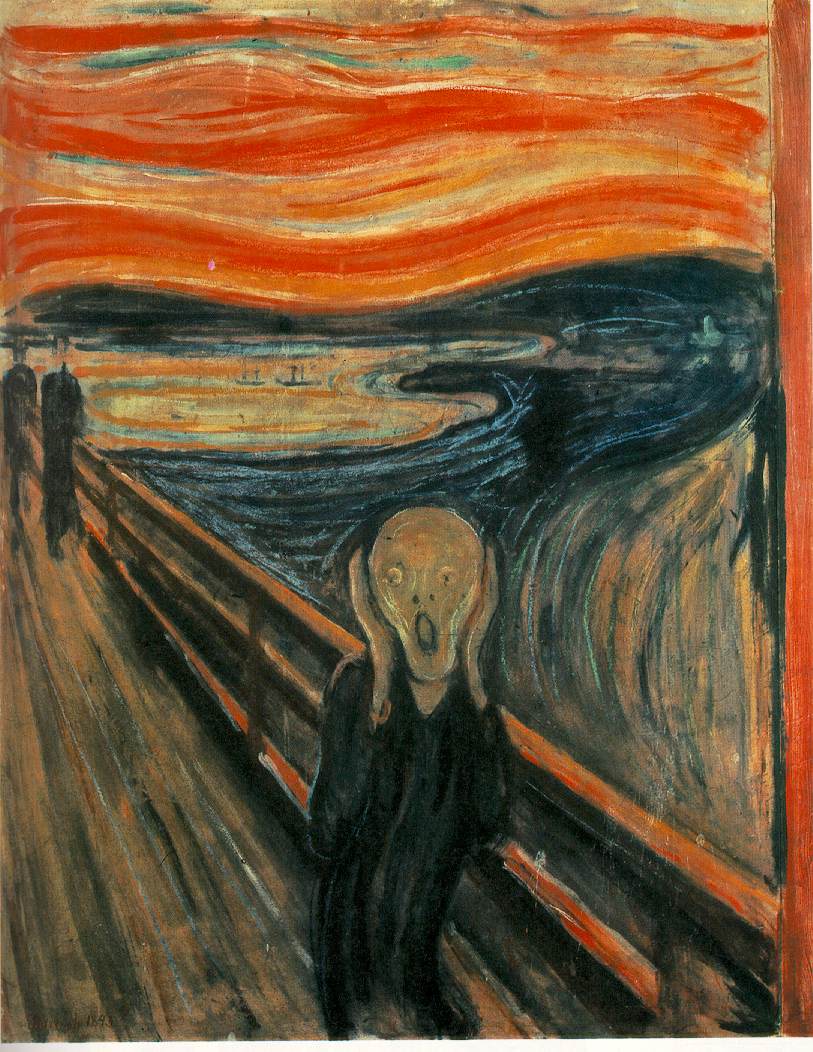
The consequence of entering the symbolic realm, the realm of language, metaphor, image, the imaginary world--and there is no choice in this, cousin--is simply the loss of the real. Similitude is a fantasy, a dream, however, which is to acknowledge that no world in our world will be reproduced, represented, imitated, imaged, without ultimately pointing to the failure of representation. The elusive real; the seductive double. My mother and are not the same. In the dream, she is specter-real, corpse-pale, drawn in green and black with holes for eyes and her mouth formed to a scream. She is like the famous painting, yes. Probably I wrenched her face from Correa's galleria muerta where the screaming is the unheard agony of invisibility--not heard, not represented, not reflected; silent. Munch is there, while Correa's paintings themselves are not. Rather, Munch's likeness is there--the missing (because stolen) original alluded to--but not present, not really, for this internet gallery is a hologram. Correa destroyed the work after photographing it. Likeness. (Loch Ness: mythmaker myth) My mother in my dream: seductive because I mothered it, gazed into its face and saw her face and saw that it saw mine: twin seeing: but she was always already dead and I was always already waking.
Sunday, September 5, 2004
We were crossing
America. At first I was alone, as when going home. I was in an airport mall looking for the train platform and the women I used to know were there on the sidewalks and in the alleys and in parking lots, common rooms, school yards, and courthouses, as they had been before, making notes which deepen the lines in their flat-lipped faces. I had a ticket to Chicago in my hand and at my feet, on the escalator, my one heavy bag rode with me past their faces, their faces garish blue, their faces shadowed, their faces black or white, or mirrored, or reflected in the surfaces, passing. The escalator was a ferris wheel, a carousel full of black and white horses, the machine churning the same thing out again and again, where I might have found myself repeating myself, myself repeated again and again for the sake of my sake, now darkness, now lightness, now rising, now sinking again--still, still--the like in likeness: death:
but the fairgrounds went a long way out,
and I began walking. I began talking to you, cousins. Someone has drawn you in soft dark pencil, fetish and leathered, black or white--your nessie, my nessie--white or black, lithe cousins, legends, you hang on my walls. Someone has left a body in the grass, human, pale, horned as a gazelle and socket-eyed: passed away: look away, back towards where we came, where we will come again, where I will bring you back with me again and watch you look towards the cities beyond the dry river, towards the escalating windows in the sun, back again, the river rending through the many middle-americas, this side, this side, this side, this side, this side, the glass in the sun, the water drowning in sun, the drowned rising, sinking again, eddying against the bank.
See the sweet white flowers in the grass? They spread their faces, they turn their fair faces towards the fields. They are horned; they are socket-eyed. They are negatives. They are precisely alike: like that, the body in the grass stares into the sun and nothing, my cousins, and I am staring into you. Like you.
but the fairgrounds went a long way out,
and I began walking. I began talking to you, cousins. Someone has drawn you in soft dark pencil, fetish and leathered, black or white--your nessie, my nessie--white or black, lithe cousins, legends, you hang on my walls. Someone has left a body in the grass, human, pale, horned as a gazelle and socket-eyed: passed away: look away, back towards where we came, where we will come again, where I will bring you back with me again and watch you look towards the cities beyond the dry river, towards the escalating windows in the sun, back again, the river rending through the many middle-americas, this side, this side, this side, this side, this side, the glass in the sun, the water drowning in sun, the drowned rising, sinking again, eddying against the bank.
See the sweet white flowers in the grass? They spread their faces, they turn their fair faces towards the fields. They are horned; they are socket-eyed. They are negatives. They are precisely alike: like that, the body in the grass stares into the sun and nothing, my cousins, and I am staring into you. Like you.
Friday, September 3, 2004
Suppose
you're in a car with R & L, and, fancy this, you are driving down from the Morenci mines past the tunnel and conveyor belts towards the underpass where the steep blind hill makes a turn and for just two seconds--usually--all is darkness: but this time the road is lit in the industrial green lights of the mine and what you see is a gate: a high half-open chainlink gate and fence across the road, and the hood of the car meets it, neat as a hand slicing through water: click: and it is then, simultaneously, that R jumps out of the car to free us from the gate and that you discover you are now sitting on the hood where the impact thrust you through the glass, and you are hanging on for dear life, and turning back you see that R has been somehow knocked out of his clothes: click: what you see is R in sagging white briefs and a wife-beater tank running to the backside of the car: you see he is covered in blood: you see this in the headlights of an oncoming car which you immediately sensed when you realized you were trapped on top of that car mashed into the gate just waiting for the inevitable: another blind vehicle careening round the bend: click: R pushing the car from the back, you on the hood hanging on, L somewhere silent in the back (dead?), and it hits, you see it happening in the headlights rising, gathering, the whole road lit up like a fucking waiting room: suppose: R is still back there, you suppose, when it hits and the hood of the car throws you off, and flying, you are thinking of that fence, of the road beyond where you nearly got to, except that you have never seen yourself die before now, dreaming. You've hardly been able to imagine it hit.
Thursday, September 2, 2004
You want real?
But you're an octopus in a tank, a tank of water pumped through the veins, testicles, lungs, of this one known artifice: what are you writing there? That you? That's you, your reflection on the glass morphing in the ink, you in simulation. Reflect? Yes you think; you think and think you are, you see it, you, even as your reflection absolves you from your thinking, becomes another thing, a thing passing, past: what the dark glass lets go, lets loose, a reflection. Nothing more.
Something: I might be paranoid.
Something: I might be paranoid.
Subscribe to:
Posts (Atom)